
Launched by NASA in 1977, the Voyager program marked a monumental milestone in space exploration. Comprising two spacecraft, Voyager 1 and Voyager 2, the mission aimed to study the outer planets of our solar system and beyond. Voyager 1 and Voyager 2 were designed to conduct close flybys of Jupiter, Saturn, Uranus, and Neptune, providing unprecedented insights into these distant worlds. However, the Voyager mission extended far beyond the confines of our solar system, venturing into the vastness of interstellar space.
The Voyager Mission
The Voyager mission was meticulously planned to take advantage of a rare alignment of the outer planets, enabling the spacecraft to slingshot from one planet to the next, significantly increasing their velocity and propelling them towards the outer reaches of the solar system. Voyager 1 and Voyager 2 were equipped with a suite of scientific instruments to study the planets’ atmospheres, magnetic fields, and moons, as well as the interstellar medium beyond our solar system. Both spacecraft have provided invaluable insights into our solar system and beyond, from detailed closeup images of neighbouring planets to proof of volcanic activity beyond Earth. This was made possible through the spacecraft’s large dish antennas, boasting a high-gain antenna dish mounted on a boom to transmit data back to Earth. Here’s a list of other key components:
- Cosmic Ray System: Designed to detect and measure cosmic rays and high-energy particles in space, providing valuable insights into the radiation environment beyond our solar system.
- Plutonium-Powered Generators: Utilising the heat generated by the radioactive decay of plutonium-238, the generators provided electrical power to the spacecraft’s systems, ensuring continuous operation in the harsh environment of deep space.
- Hydrazine Thrusters: Used for attitude control and trajectory adjustments, the hydrazine thrusters allowed the spacecraft to maintain its orientation and make precise course corrections during its long journey through space.
- Infrared Interferometer and Ultraviolet Spectrometers: These instruments were used to analyse the composition and properties of planetary atmospheres, providing valuable data on temperature, pressure, and chemical composition.
- Imaging Science System: Equipped with cameras and imaging sensors, the imaging science system captured stunning photographs and visual data of the planets, moons, and other celestial objects encountered during the mission.
The Golden Record
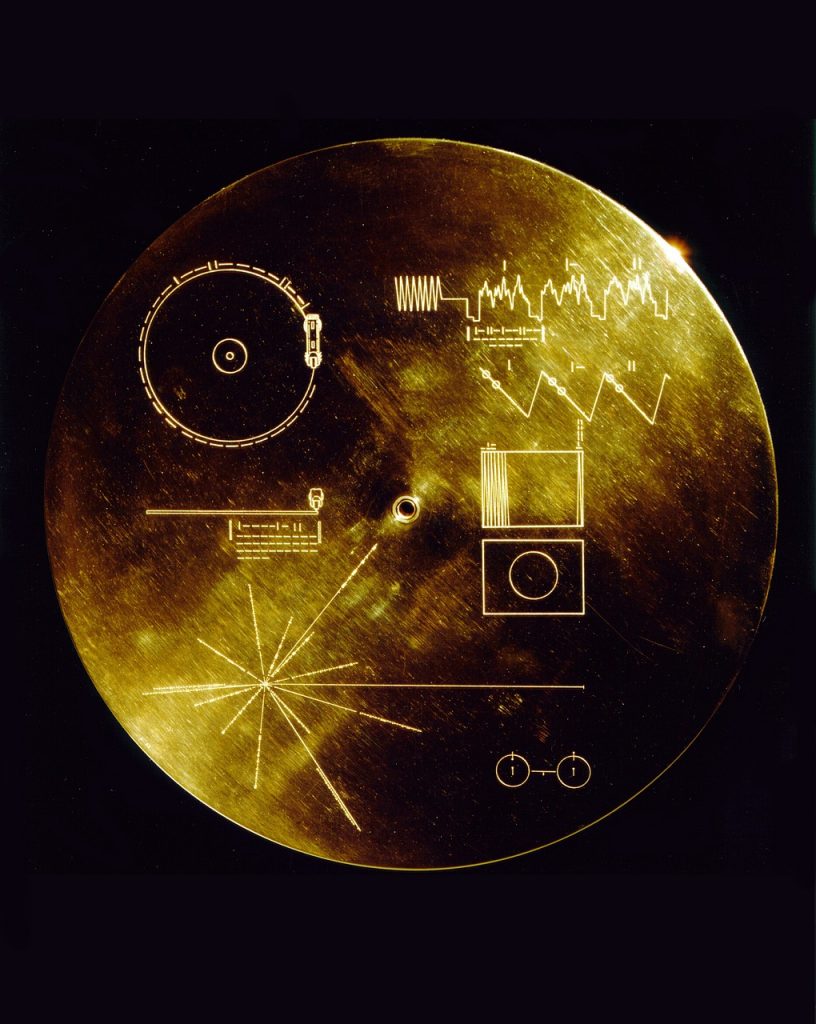
A highlight of the Voyager mission was the inclusion of the Golden Record—a 12-inch gold-plated phonograph record containing sounds and images representing Earth’s rich diversity of life and culture. Crafted under the supervision of Carl Sagan and his team, the Golden Record was intended as a message to potential extraterrestrial civilisations, showcasing the beauty and complexity of life on Earth. The record included greetings in 55 languages, along with a selection of music from different cultures and eras, ranging from Beethoven to Chuck Berry. It also featured natural sounds of Earth, such as thunder, wind, and animal calls, as well as images depicting human anatomy, civilisation, and scientific concepts. Have a listen to the interstellar record below!
The Journey of Voyager

Since its launch in 1977, Voyager 1 has embarked on an epic journey through the depths of space, surpassing all expectations and venturing into the realm of interstellar space. Traveling over 14 billion miles from Earth, Voyager 1 has provided humanity with a unique perspective on the cosmos, capturing breathtaking images of distant planets, moons, and celestial phenomena along the way. One of the most iconic moments in Voyager’s journey occurred on February 14, 1990, when renowned astronomer Carl Sagan, a member of the Voyager imaging team, proposed a daring idea to turn the spacecraft’s camera back towards Earth for one last glimpse of our home planet before it disappeared into the vastness of space. This historic manoeuvre resulted in the creation of the “Pale Blue Dot” image, a humbling reminder of the fragility and beauty of our planet as seen from the perspective of deep space. It was humanities first cosmic selfie.
In his book “Pale Blue Dot: A Vision of the Human Future in Space,” Sagan eloquently reflected on the significance of the image, describing Earth as a “mote of dust suspended in a sunbeam” and urging humanity to cherish and protect our shared home in the cosmos. The “Pale Blue Dot” image continues to inspire awe and reverence for the interconnectedness of all life on Earth and the preciousness of our planet in the vastness of the universe. Whenever I see this humbling image, I am reminded of humanities self-centred nature and our micro level mindset that acts as a constant barrier between humans and the cosmos. When will we learn that there is more to existence than a fraction of land on a mote of dust?
Houston… We have a problem…
Despite their remarkable achievements, the Voyager spacecraft have encountered their fair share of challenges and technical issues during their decades-long journey through space. Both Voyager 1 and Voyager 2 have experienced occasional glitches and malfunctions, requiring innovative solutions from mission controllers on Earth to keep the spacecraft operational. In recent years, Voyager 1 faced a particularly alarming setback when it unexpectedly lost communication with NASA’s Deep Space Network, resulting in a temporary blackout of data transmission (This has occurred a few times with both Voyagers). However, to the relief of scientists and engineers, Voyager 1 has since resumed communication and continues to transmit valuable data from the far reaches of the solar system. This unexpected resurgence serves as a testament to the resilience and durability of the Voyager spacecraft, as well as the dedication and expertise of the mission team tasked with overseeing their operations. Despite the challenges encountered along the way, Voyager 1 and Voyager 2 remain steadfast in their mission to explore the cosmos and unravel the mysteries of the universe.
Legacy and Inspiration
The legacy of the Voyager mission extends far beyond its scientific discoveries. Voyager 1 and its sister spacecraft have inspired generations of scientists, engineers, and space enthusiasts, demonstrating the power of human ingenuity and exploration. Their enduring journey through the cosmos serves as a testament to the curiosity and ambition of humanity, urging us to continue pushing the boundaries of knowledge and understanding in our quest to explore the universe. However, it’s important to recognise that their journey also urges us to truly appreciate our hint of existence, on the mote of dust we call home.
Stay curious, Kairo
Cassiotrio team