
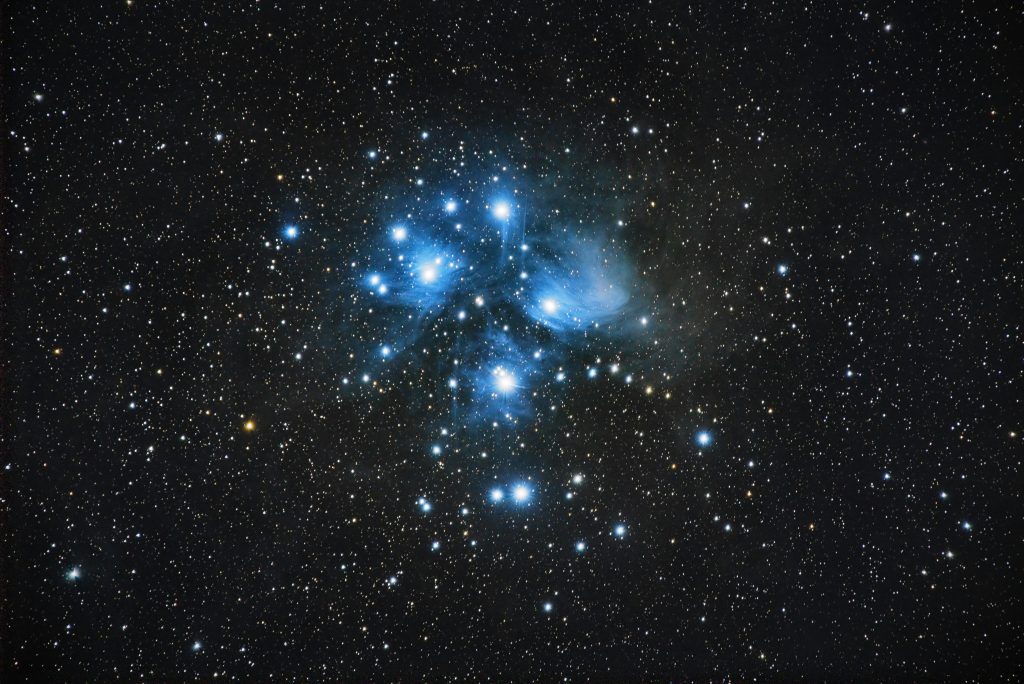
Nestled within the celestial tapestry of the night sky lies a cluster of stars that has captivated the imagination of cultures around the world for millennia. Known as the Pleiades, or the Seven Sisters, this beautiful star cluster has inspired myths, legends, and scientific inquiry throughout history. Join us as we embark on a journey to unravel the mysteries of the Pleiades and discover the enchanting story behind these celestial siblings.
The Celestial Ballet
The Pleiades, also cataloged as Messier 45 or M45, is an open star cluster located in the constellation of Taurus. Visible to the naked eye as a hazy patch of stars, the Pleiades cluster is comprised of hundreds of young, hot stars formed from the same cosmic cloud of gas and dust. However, only a handful of these stars are readily discernible to most observers, giving rise to the cluster’s nickname, the Seven Sisters.
Myth and Legend
Across cultures and civilisations, the Pleiades have been associated with a multitude of myths and legends. In Greek mythology, the Pleiades were seven sisters, daughters of the Titan Atlas and the sea nymph Pleione. Pursued by the hunter Orion, the sisters were transformed into stars to escape his advances, forever frozen in the night sky.
Scientific Insights
Beyond their mythological allure, the Pleiades have also captured the attention of astronomers seeking to unravel the mysteries of stellar evolution. As one of the nearest star clusters to Earth, the Pleiades provide a unique opportunity to study the formation and evolution of stars.
Recent observations and studies have revealed fascinating insights into the properties of the Pleiades stars, their age, and their motion through space. By analysing the motion of the stars within the cluster, astronomers have been able to estimate its age at approximately 100 million years, making it a relatively young cosmic sibling compared to the billions of years old stars that populate the Milky Way. To the dinosaurs, the Pleiades stars appeared as newborns, radiating their light from within the vast stellar nursery of the cosmos.
Key word: Asterism
Asterisms are informal star patterns, not an official constellation. This is NOT the pleiades as while often referred to as an asterism due to its distinctive grouping of stars, the Pleiades is officially recognised as an open star cluster by astronomers.
Stargazing Tips for Observing the Pleiades
The Pleiades offer a breathtaking celestial spectacle that can be enjoyed during the winter months, especially between October and March. Here are some tips to help you make the most of your stargazing experience:
- Choose a Clear Night: Keep an eye on weather forecasts and aim to stargaze on clear, moonless nights for the best visibility. Light pollution can also affect your viewing experience, so consider heading to a dark sky location away from city lights if possible.
- Find a Dark Sky Location: While the Pleiades can be visible from urban areas, their delicate beauty is best appreciated under dark skies. Seek out designated dark sky sites or remote rural locations away from artificial light sources for optimal viewing conditions.
- Locate the Constellation of Taurus: To find the Pleiades, first locate the constellation of Taurus, the Bull, in the eastern sky during the winter months. Look for the distinctive V-shaped cluster of stars representing the Bull’s face, with the bright red star Aldebaran marking one of its eyes.
- Spotting the Seven Sisters: Once you’ve located Taurus, direct your gaze slightly above and to the right of Aldebaran to find the Pleiades cluster. With clear skies and good visibility, you should be able to spot the Seven Sisters as a hazy patch of stars resembling a tiny dipper or miniature version of the Big Dipper.
- Use Binoculars or a Telescope: While the Pleiades are visible to the naked eye, binoculars or a small telescope can enhance your viewing experience by revealing the cluster’s intricate structure and fainter stars. A pair of binoculars with a wide field of view is ideal for capturing the full beauty of the Pleiades.
- Take Your Time: Spend some time observing the Pleiades and allow your eyes to adjust to the darkness. Look for subtle variations in brightness and colour among the stars, and immerse yourself in the beauty of this ancient star cluster.
- Capture the Moment: Consider bringing a camera or smartphone equipped with a night mode to capture images of the Pleiades and create lasting memories of your stargazing adventure. Experiment with different exposure settings to capture the cluster’s delicate beauty against the backdrop of the night sky.
The Pleiades stand as a celestial testament to the enduring power of mythology, the beauty of the cosmos, and the wonders of scientific exploration. Whether viewed through the lens of ancient myth or modern science, the Seven Sisters continue to inspire awe and wonder in all who gaze upon them. Join us in celebrating the splendor of the Pleiades and let their shimmering light guide you on your journey through the night sky.
This post brings an end to January’s star-gazing. January’s star-gazing posts have illuminated the wonders of the night sky, but the celestial journey doesn’t end here! Stay tuned for more captivating discoveries and thrilling adventures in February.
Clear skies, Kairo
Cassiotrio Team